
Sometimes a single word travels farther than its own sound. It picks up stories from people’s mouths, dances across continents, and suddenly you’ll hear it whispered in a café in Istanbul or typed lovingly in a late-night group chat somewhere in Brazil. The Korean word Unnie (언니) is one of those tiny travelers.
I still remember the first time a Korean friend laughed and said, “You can call me unnie if you like.” I wasn’t even sure how to hold the sound in my mouth, but there was this warm softness around it, almost like saying “big sister” with a hug stitched inside the vowels.
And it’s funny how words like this, which bloom from Korean culture, can become little bridges. You step onto them without fully realizing how much history or emotional weight they’re carrying.
Sometimes you’re just trying to show a bit of respect, sometimes you wanna express a little affection, and sometimes you’re simply trying to keep up with what the girls in your chat group are saying after binge-watching K-dramas.
Before you know it, you’re using “unniee” in your online chats or scribbling it in DMs, even if your own older sister probably has no clue why she’s suddenly being addressed in Korean. That’s the charm though the way language and culture slide into each other like warm tea into a small ceramic cup.
In this article, we’ll explore the unnie meaning, how the word moves in conversations, how people use it in social media, why the age hierarchy matters in the Korean language, and how you can use it without sounding like you copy-pasted everything straight out of a K-pop fanbook.
Let’s walk through it gently, with stories and slips and a few lovingly “imperfect” sentences — because that’s how language really lives.
What Does Unnie Meaning
| Term | Meaning | Who Uses It | Who It Refers To | Context |
|---|---|---|---|---|
| Unnie (언니) | Older sister / older female friend | Younger females | Older females | Casual speech, K-pop, K-dramas, texting |
| Unnie Meaning in English | “Older sister” or “older girl you are close to” | Girls/women | Older female they respect | Everyday conversations, online chats |
| Meaning of Unnie | Warm, affectionate female-to-female address term | Younger girls | Older sisters, close older friends | Korean culture, social media, fandom |
| How It’s Used | To show respect, closeness, or admiration | Females only | Older female | Speech, DMs, fandom chats |
| Unnie Tone | Friendly, affectionate, sister-like | Younger female speakers | Older female friends or idols | Informal communication |
| Unnie Alternatives | Sis, big sis, eonni, noona (for boys), Ms., senior | Anyone | Depends on formality | Casual or respectful settings |
What Does Unnie (언니) Mean? A Soft Word With Strong Roots
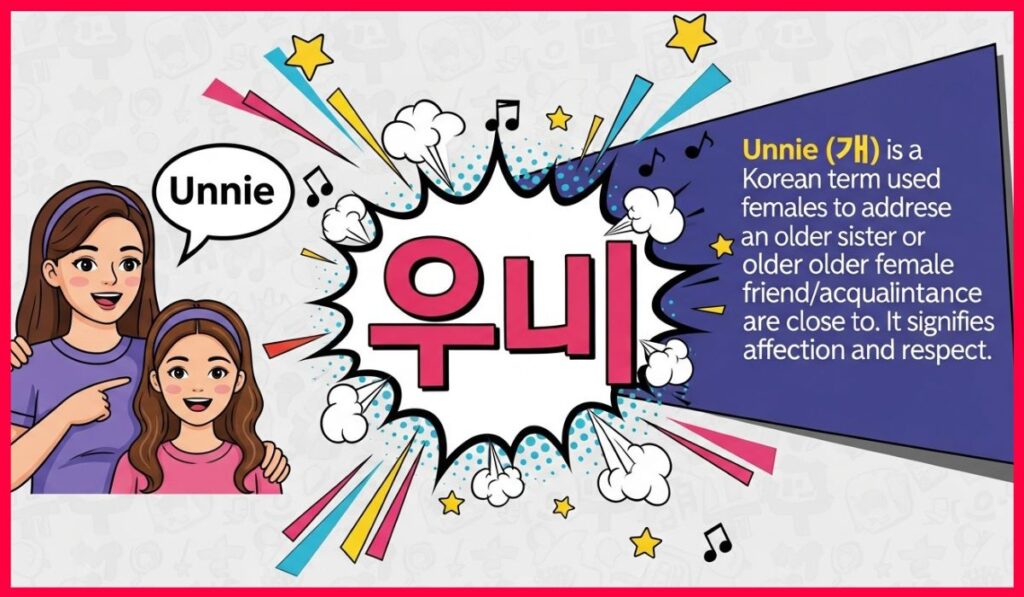
If you boil it down to its simplest definition, unnie means “older sister” — but only when the speaker is a woman. This is one of those gender-specific Korean terms that doesn’t translate cleanly into English because English doesn’t care whether a younger girl calls her older sister in a different way than a younger boy would. But Korean does. Deeply.
This is where the age hierarchy in Korean culture steps onto the stage wearing very fancy shoes. Every relationship has a shape in Korean society, and words like unnie, oppa, noona (누나), or eonni-nim (언니님) tell you exactly where people stand in that invisible social staircase.
But here’s the thing:
In daily use, unnie (언니) is not stiff or formal. It’s warm. Soft. Familiar. A girl uses it to address an older female friend, a beloved mentor, even sometimes a celebrity she admires in K-pop fandom circles.
Its energy says:
“You’re above me in age or experience, but close enough that I feel safe calling you family.” That’s the real unnie meaning.
How Unnie Is Used in Text Messages, DMs, and Online Chats
If you’ve ever jumped into K-drama comment sections or scrolled stan Twitter during a comeback season, you’ve already seen how wild and creative people get with “unnieeeeee” and “unniii plz adopt me.”
When girls type to their older female friends online, the texting style often changes depending on the mood.
In friendly casual texting, “unnie” might look like:
- “unniee did u eat??”
- “my unniiii is so pretty today omg”
- “thank u unnie, u saved my whole day frfr”
On social media, especially inside fandom / online communities, the word becomes playful, dramatic, exaggerated — almost like cosplay through language.
- “Fashion unnie save us we drowning in ur outfit pics”
- “bestie? no you’re my unnie now idc idc”
The vibe swings between cute admiration and affectionate teasing. It’s a word that can stretch, shrink, bend, sparkle — depending on how you type it.
It also shows up when talking about someone:
- “She’s like a soft unnie vibe, you know?”
- “That singer gives older-sister energy, total unnie look.”
This is how Korean texting language slips into global internet culture.
Unnie in Korean Culture: Why This Word Matters More Than People Realize

To understand unnie, you must swim a little in the river of Korean culture, where relationships are carefully shaped by age, respect, and emotional closeness. Calling someone unnie is not just labeling them by age; it’s telling them:
- I acknowledge you
- I trust you
- I give you a small gentle bow with my words
Korean society uses Korean honorifics like stepping stones — you choose them depending on the formality, familiarity, and the social space you’re standing in.
But unnie stands out because it’s a female-to-female address term full of affection. It gives warmth instead of distance. It creates belonging.
Sometimes people say it even when they’re not actually that close but wish to be. A fan might call their favorite singer “unnie” to show emotional admiration. A foreigner might say it to feel included in a cultural circle. And Korean girls say it because the word is a home they’ve grown up in.
Storytime: The First Time Someone Called Me Unnie
There’s always this soft little moment when someone uses a culture’s word for the first time on you. I was in a Korean café with two friends; one was younger by maybe three or four years. She handed me a drink and said casually, “Here you go, unnie.”
It was so gentle I nearly dropped the cup.
In that tiny syllable, she placed me in a role I didn’t even realize I’d stepped into — someone she trusted, someone slightly older who might know a thing or two about life (which is debatable, but sweet of her to assume).
Words can assign relationships without ever signing a contract. That moment taught me more about conversational Korean etiquette than any textbook.
Different Emotional Tones of Unnie in Daily Communication
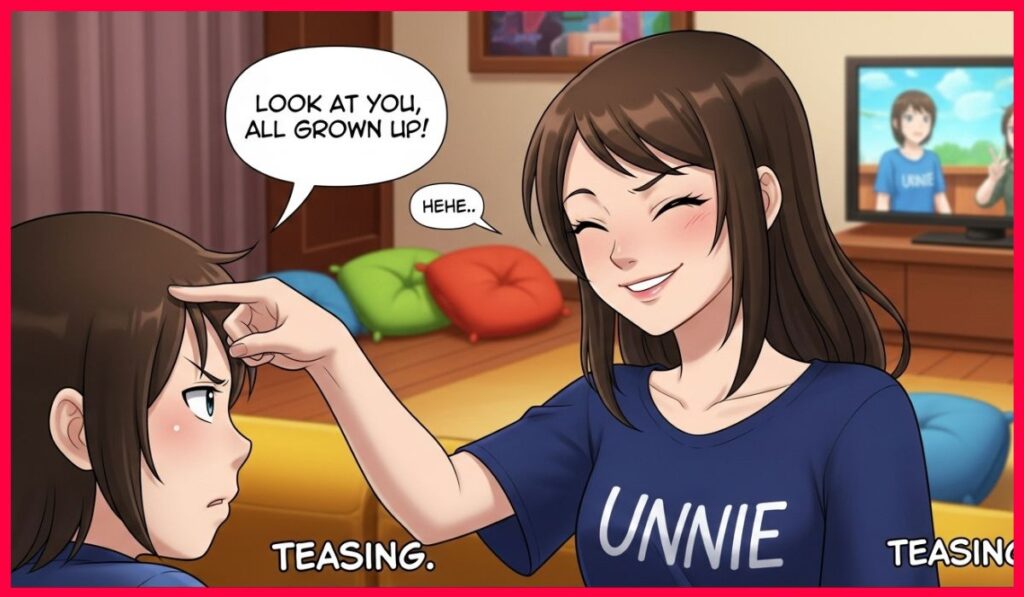
Girls use unnie in loads of ways, each tone carrying its own flavor:
1. Warm & Affectionate
- “unnie I miss u sm today”
- “thank u for looking out for me, really”
2. Playful & Teasing
- “unnie stop pretending u not obsessed with ramen”
- “okay unnie boss me around if u must lol”
3. Admiring (often seen in fandom)
- “hair like that??? unnie teach me ur ways”
- “she is THE fashion unnie”
4. Calm & Respectful
- “unnie, may I ask u something important?”
- “I appreciate your advice, unnie.”
5. Sad or Emotional
- “unnie I don’t know how to get through this day”
- “stay with me on call for a bit pls”
Unnie shifts its shape depending on the closeness and emotional temperature of the moment.
Unnie vs Noona: Clearing the Confusion Once and For All
People often mix the two, but the difference is simple:
- Unnie (언니) = What a woman calls her older sister/older female friend.
- Noona (누나) = What a man calls his older sister/older female friend.
Both are part of the Korean honorific system, and both express respect mixed with affection.
But they’re not interchangeable — unless you want Korean speakers giggling a little.
Is Unnie Professional? When to Avoid It
In a workplace, especially for formal emails or messages, “unnie” usually sounds too personal unless the environment is extremely casual.
Use professional alternatives to unnie, like:
- Ms. Kim
- Ms. Park
- Manager
- Supervisor
- Director
- Senior female colleague
- Respected colleague
These sound more like professional communication and less like a cozy café conversation.
If you want to soften the tone while staying respectful, you can use polite alternatives to unnie such as:
- “Ma’am”
- “Ms.”
- “Senior”
- “Team lead”
These won’t cross any boundaries.
Casual Alternatives to Unnie in Friendly Speech
When texting friends who feel like sisters but you don’t wanna use Korean terms, try:
- Big sis
- Sis
- Bestie
- Buddy
- Pal
- Girl
- Girlfriend (as slang)
These work great in international contexts where informal Korean speech might not feel natural.
Fandom Culture & The Rise of Unnie in Online Communities
Inside K-pop fandoms, the word unnie has evolved and mutated like a cute, overly excited Pokémon.
Fans use it to:
- express admiration
- show closeness
- jokingly “adopt” idols
- soften criticism (“unnie that outfit is a lil crazy but I support u”)
- build emotional community
And during comeback seasons, people sometimes go on “unnie hiatus,” which gives birth to funny phrases like:
- “The hiatus meaning hits diff when ur unnie disappears for 3 months.”
Language in fandoms grows its own branches, and unnie sits right in the middle of it like a comfy treehouse.
How Unnie Appears in K-Dramas (And How It Spread Worldwide)
K-dramas taught millions of people the emotional architecture of Korean relationships. When you hear a younger girl shout “Unniee!” to chase after an older friend, you feel the bond instantly.
In dramas, unnie is often used to show:
- sisterly comfort
- emotional vulnerability
- admiration
- frustration mixed with love
- family bonds
- friend groups with strong ties
This consistent portrayal made “unnie” a global word, understood even by people who’ve never taken a Korean language class.
Unnie in Social Media Slang: Cute, Chaotic, and Everywhere

In online chats, you’ll see girls type:
- “unnie adopt me”
- “unnie I can’t breathe ur selfies too pretty”
- “unnie teach me life pls”
It’s basically affectionate chaos.
And it works because the internet loves emotionally charged words that feel like hugs with extra sparkles.
Unnie Meaning in Different Communication Styles (Warm, Poetic, Humorous, etc.)
Here are some ready-to-use messages in different tones (per your instructions, no numbering, just bullets):
Warm & Heartfelt Ways to Address an Unnie
- You always give me that older-sister comfort even when you don’t notice it.
- Sometimes I wonder how you manage to stay so calm, unnie, and it kinda inspires me.
- When you say my name, it feels like someone finally plugged in a missing piece.
- Unnie, your advice lands softly but somehow changes everything.
- I didn’t grow up with a big sister, but having you feels pretty close.
- You make being younger feel less scary.
- Thanks for every small thing you don’t even know you do.
Humorous / Playful Messages
- Unnie stop lying, you know you’re the drama and the main character.
- If wisdom was a snack, unnie, you’d still choose ramen.
- Unnie I swear you’re 3% human and 97% iced coffee.
- You call it advice, I call it life-saving cheat codes.
- If chaos had a manager, it would be you, unnie.
- Unnie please teach me how to adult. I’m failing respectfully.
- You’re older but honestly you act younger sometimes lol.
Poetic & Soft
- The world feels a little warmer when you say “come here.”
- You’re like a small lantern, unnie, glowing even in daylight.
- When your voice softens, it feels like the sky bends closer.
- There’s something gentle about you that speaks louder than words.
- Some people teach by speaking; you teach by simply existing.
- A day with you nearby feels less tangled.
- You’re the kind of unnie who makes life whisper instead of shout.
Polite Communication: How to Address Older Women Respectfully Without Using Unnie
If you’re writing to someone older in a formal or international context, these work well:
- Dear Ms. Kim,
- Hello respected colleague,
- Good afternoon ma’am,
- Hello senior team member,
- Dear Director Park,
- Dear Supervisor,
- To our senior female colleague,
These keep things smooth and professional without crossing cultural lines.
Quick Guide: When Should You Use Unnie (And When Should You Not)?
Use unnie when:
- you’re a girl speaking to an older female friend
- the relationship is warm or sisterly
- the context is casual
- you’re messaging someone who’s okay with informal Korean terms
- you’re engaging in K-pop or K-drama culture
Avoid unnie when:
- writing professional emails
- addressing teachers, bosses, or officials
- unsure about the age difference
- the setting is formal
- the person seems uncomfortable with Korean honorifics
How to Choose the Right Tone When Calling Someone Unnie
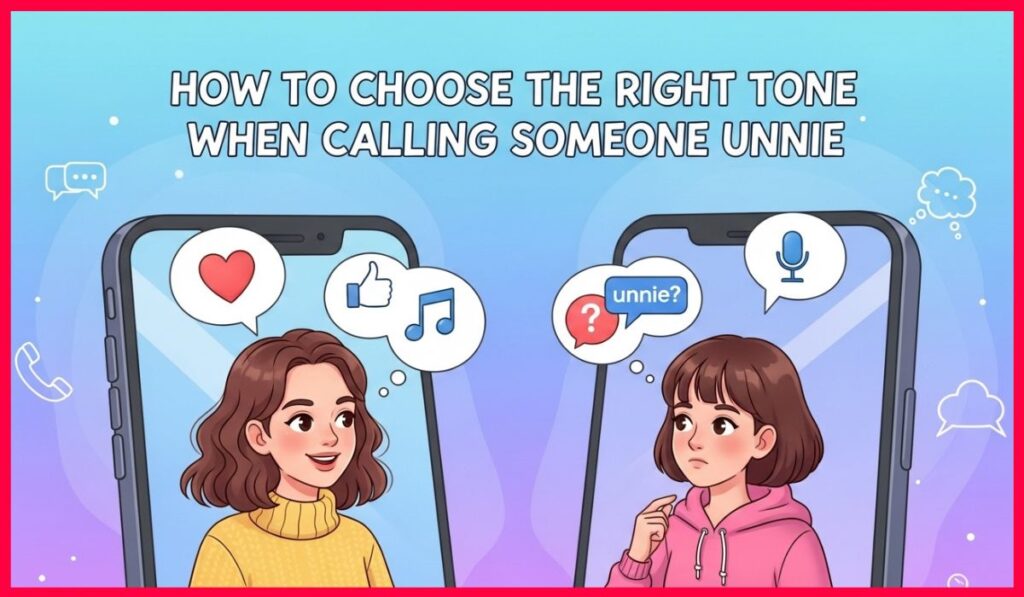
Think about the emotional landscape:
- Affectionate? Go soft: “unniee~”
- Casual? Just “unnie.”
- Playful? Stretch the vowels: “UNNIEEE stahppp”
- Emotional? Keep it short and simple: “Unnie.”
Let the relationship lead the spelling, not the dictionary.
Alternatives to Unnie (Formal, Polite, and Casual)
Formal / Professional
- Ms.
- Mrs.
- Miss
- Manager
- Director
- Senior
- Supervisor
Polite Korean
- Eonni-nim (언니님)
- Seonbae (선배)
Casual / Friendly
- Big sis
- Sis
- Bestie
- Pal
- Girl
- Buddy
These help you navigate safely through both casual and formal communication.
Related Terms: Quick Mentions of OMY Meaning & LWK Meaning
Since many readers explore slang clusters together, it’s helpful to nod to related expressions like OMY meaning or LWK meaning, which circulate in the same digital spaces as unnie. They often appear in online slang discussions and show how global internet culture blends humor, ease, and chaos into communication.
If you wanna craft your own message that feels natural and heartfelt:
- Mention a shared memory or moment.
- Add a small playful flaw — it makes the message human.
- Use an affectionate tone but don’t exaggerate if it’s not your style.
- Keep the message short enough to feel real, long enough to mean something.
- Don’t force Korean terms if they don’t fit your relationship.
Authenticity always beats aesthetics.
Freqeuntly Asked Questions
unnie meaning in english
Unnie means “older sister” in English, used by a younger female to address an older female with affection and respect. It can also mean an older female friend who feels like a sister.
meaning of unnie
Unnie is a warm Korean term used by girls to refer to an older female, showing closeness, trust, and friendly respect. It’s common in K-dramas, K-pop, and everyday Korean speech.
unnie meaning
Unnie means an older girl or woman you feel close
Conclusion
Unnie isn’t just vocabulary.
It’s belonging.
It’s warmth.
It’s a small linguistic gesture that says, “I see you. I respect you. I’m close to you in a way that matters.”
And even if you’re not Korean, even if you learned the word from a K-drama binge at 2 a.m. or from a friend who insisted you join their K-pop fandom group chat, the meaning still resonates.
Because every culture, every family, every heart understands what it feels like to reach for someone older and say, “Guide me, tease me, walk with me a bit.”

Food lover, recipe creator & the heart behind NoshCrafters.com. Olivia shares mouthwatering, easy-to-make dishes that turn everyday meals into unforgettable bites. When she’s not experimenting in the kitchen, she’s busy plating up inspiration for home cooks everywhere.