
Sometimes, when you first decide to step into the world of investing, it feels a bit like standing in a quiet room where the walls are made of questions. You clutch your small savings, maybe a humble 50 bucks or a shy little 100, and you wonder if it’s even worth trying. And somewhere in the back of your head, a tiny voice whispers, “People like me… do we even belong in the stock market?”
I remember feeling that exact same jittery hopefulness the first time I opened a commission-free trading app. My hands were kinda sweaty, lol, I thought one wrong tap would explode my account (not literally, obviously).
But funny thing is — that tiny start became the best decision I made for my future self. See, you don’t need mountains of cash. You just need a bit of courage, the right mindset, and a sprinkle of good, sensible financial concepts that make the journey less foggy and more friendly.
Let’s walk together through this world of starting with little money and see how you can make your first investment steps feel like opening a small window into a larger life.
| Category | Examples / Options | Why It’s Beginner-Friendly |
|---|---|---|
| Fractional Shares | Amazon, Google, Apple | Buy expensive stocks in small amounts |
| ETFs | Vanguard Total Stock Market ETF (VTI), SPDR S&P 500 ETF (SPY) | Diversification, broad market exposure, low-cost |
| Dividend Stocks | Coca-Cola (KO), Procter & Gamble (PG), Johnson & Johnson (JNJ) | Steady income, long-term growth |
| Growth Stocks | Apple (AAPL), Microsoft (MSFT), Amazon | Potential for stock appreciation, long-term compounding |
| Brokerages / Trading Platforms | Robinhood, Webull, M1 Finance, Fidelity, Charles Schwab | Commission-free trading, beginner-friendly apps |
| Investment Strategy | Dollar-cost averaging, consistent investing | Reduces market volatility risk, encourages personal finance growth |
| Learning Resources | The Intelligent Investor, A Random Walk Down Wall Street, Investopedia | Builds understanding company fundamentals, avoids beginner mistakes |
Understanding the Beauty of Small-Budget Investing
There’s a sweetness in small budget investing that big investors sometimes forget. When you’re buying your first shares / fractional shares, you are literally owning a microscopic piece of a real business real humans, real products, real stories. It’s not just numbers dancing on your phone. It’s ownership in a company that might be serving your coffee, powering your Wi-Fi, or delivering your groceries.
People often think investing requires wealth, fancy suits, and reading newspapers with overly serious faces. But honestly, with zero-commission brokers like Robinhood, Webull, M1 Finance, Fidelity, and Charles Schwab, you can start investing small amounts, maybe the price of a pizza.
And guess what? Through fractional share investing, you can even buy a piece of Apple (AAPL) or Amazon without needing to drop $100+ in one go. You just choose how much you want to put in — maybe $5, maybe $11.37 because it’s all you had that week — and boom, you’re in.
Why Beginners Should Love ETFs
I like to imagine Exchange-Traded Funds (ETFs) as big cozy baskets filled with dozens, sometimes thousands of little company stories. Instead of trying to hand-pick “the perfect stock,” you get a smooth slice of the entire market.
ETFs are the friend who says, “Relax yaar, diversify a bit,” because diversification protects you when one company has a bad day. And trust me, companies have bad days like all of us do — sometimes for reasons that make no sense at all.
Two of the most beginner-friendly ones are:
- Vanguard Total Stock Market ETF (VTI) — gives you total stock market exposure, like holding a tiny stake in the entire US economy
- SPDR S&P 500 ETF (SPY) — tracks the 500 biggest companies
These are perfect for beginner-friendly stocks situations because they’re stable, low-cost, and quietly grow through long-term compounding.
Fun fact: many beginners read Investopedia late at night, pretending they understand everything on the first try. Don’t worry, nobody does. We all nod like “ah yes, fundamentals” while googling “what are fundamentals??”
The Magic of Compounding and Dollar-Cost Averaging
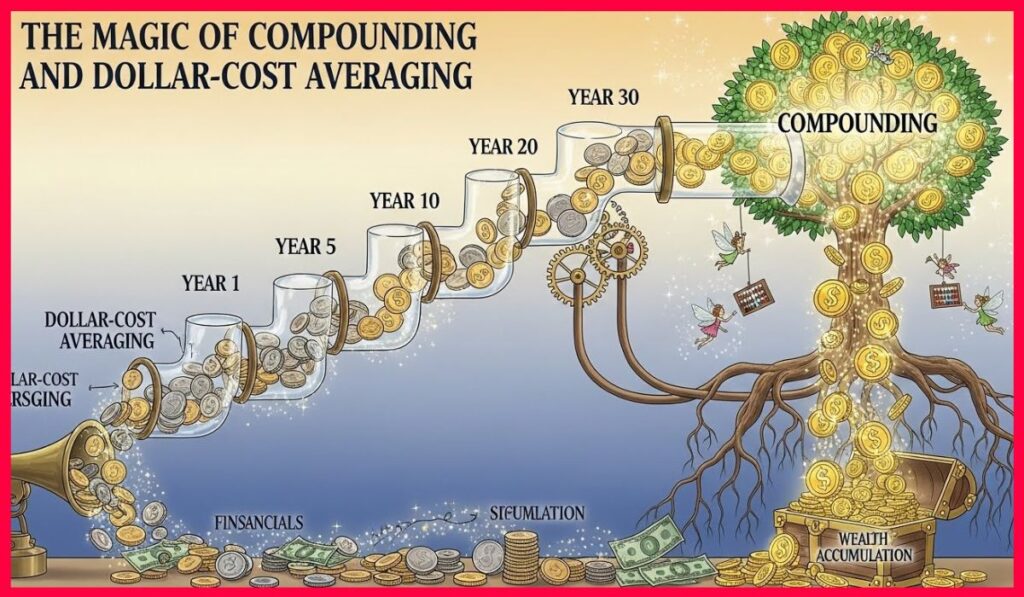
If there’s one thing that feels like a fairy tale in finance, it’s compounding. Money growing on top of money, stacking like quiet little bricks until one day you look back and your dusty little $100 has turned into something meaningful.
Pair that with dollar-cost averaging — the habit of investing small amounts regularly, whether the market volatility is wild or peaceful — and suddenly you’re building wealth without stressing every single price movement.
Beginners sometimes think they need to predict the perfect moment to buy, but honestly, market timing is a game even pros lose. Your strength is consistency, not accuracy.
Best Stocks for Beginners with Little Money: Accessible, Steady, and Friendly
Let’s get into some beginner-friendly stocks, ones that are well-known, stable, and suitable when you want investing with little money.
Remember, these are not magic tickets. They’re simply reliable places where beginners often start because they have strong business models, better cash flow, and clear quarterly reports.
Here are some of the most trusted, beginner-loved companies:
- Coca-Cola (KO) — Many people call it a “sleep-well-at-night stock.” With decades of strong branding, KO is known for being one of the most stable dividend stocks
- Procter & Gamble (PG) — From toothpaste to detergent, they sell everyday essentials. It’s like owning a tiny piece of every bathroom cabinet
- Johnson & Johnson (JNJ) — A healthcare giant with a reputation for stability and long-term dividend-paying companies
- Apple (AAPL) — A favorite for new investors. Strong growth, loyal customers, and ecosystem so sticky you feel trapped but happy
- Microsoft (MSFT) — Cloud computing beast, steady growth, and a safe place for long-term investing
- Visa (V) — Quietly earns money every time someone uses a card. A great pick for stock appreciation seekers
- Amazon and Google — These two are the kings of tech growth stocks, perfect for those looking for long-term compounding and growth stocks exposure
Beginners also love investing small amounts into Dividend Aristocrats, companies that have raised dividends for 25+ years. Perfect for passive income through dividends.
Read this Blog: https://noshcrafters.com/pedrovazpaulo-executive-coaching/
Mistakes Beginners Often Make Without Realizing
Nobody enters the market planning to mess up, but hey, beginners make adorable, predictable mistakes. Including me, including you maybe, including everyone who once felt like a newborn deer trying to walk on ice.
Here are some common slip-ups:
- Chasing hot tips from cousins, WhatsApp groups, or that one coworker who “knows everything”
- Emotional decision-making — selling in fear, buying in excitement
- Panic selling during dips instead of holding steady
- Neglecting research, which leads to buying stocks you can’t even explain
- Trying market timing, thinking you will catch the bottom. Spoiler: you probably won’t
Stick to a calm plan, understand understanding company fundamentals, and build consistent investing habits.
Why Fractional Shares Changed Everything for Small Investors

Once upon a time, beginners needed enough cash to buy a full stock. So if Amazon was $100+ per share, tough luck. But now with fractional shares, the gates are wide open.
This changed the entire landscape of low-cost investing and how to invest small amounts without stress. It lets you:
- Buy expensive companies in tiny pieces
- Build a diversified portfolio quickly
- Practice risk management for beginners by spreading out small chunks
Fractional shares are one of the biggest blessings for beginner investing. Like opening a door that was always locked with a fancy golden key you didn’t have before.
Building Your First Portfolio with Confidence
Let’s paint a quick picture of how a beginner might structure a simple, solid portfolio:
- 60% into broad ETFs like VTI or SPY
- 20% into stable dividend stocks such as PG, KO, or JNJ
- 20% into growth stocks like AAPL, MSFT, Amazon, or Google
This is just a friendly example, not strict advice. Your goals might be different. But the idea is the same: combine stability with growth, sprinkle in dividends, protect yourself with diversification, and let compounding do its quiet magic.
A Few Investing Lessons from People Who’ve Been There
One grandpa once told me, “Beta, investing is like planting mango trees. You don’t shout at the soil daily; you water it and wait.” His words stuck with me more than any chapter from The Intelligent Investor – Benjamin Graham or A Random Walk Down Wall Street – Burton Malkiel.
Real investors don’t obsess over every bump. They trust time.
How to Write Your Own Investing Strategy
Your plan doesn’t need to be perfect. It just needs to be:
- Simple enough to follow when emotions get messy
- Flexible enough to grow with your life
- Aligned with your goals — buying a house, retirement, or just learning the game
A strategy is like a compass. Not a cage.
Frequently Asked Questions
What is the best way to start investing with little money?
Start with fractional shares or ETFs through commission-free trading apps like Robinhood or M1 Finance.
Can I really grow wealth with just $50–$100?
Yes! Consistent investing and dollar-cost averaging let small amounts grow over time via compounding.
Which stocks are beginner-friendly for small investments?
Look at stable dividend stocks like KO, PG, JNJ, or growth stocks like AAPL and MSFT for long-term growth.
Do I need to worry about market volatility?
Not too much — start small, diversify with ETFs, and focus on long-term investing instead of short-term swings.
Are there resources to learn while investing small amounts?
Yes, books like The Intelligent Investor, A Random Walk Down Wall Street, and websites like Investopedia are perfect for beginners.
Conclusion
If you’re investing with little money, don’t ever feel like your tiny start is insignificant. Every big investor was once a beginner staring at their first $10 investment with hopeful eyes.
Your journey into the stock investing world is not about being perfect — it’s about being present, learning, growing, and allowing yourself to build something meaningful over time.
Start small. Stay steady. Let your future self look back with gratitude and say, “I’m glad I started when I did, even if it felt scary.”
And hey, if you ever feel unsure, ask questions, read more, explore resources like financial learning resources or stock research basics, and keep moving forward.

Food lover, recipe creator & the heart behind NoshCrafters.com. Olivia shares mouthwatering, easy-to-make dishes that turn everyday meals into unforgettable bites. When she’s not experimenting in the kitchen, she’s busy plating up inspiration for home cooks everywhere.