
When you first hear the word “kroner,” it might sound like something pulled from a Nordic fairytale—a term whispered in snowy villages or stamped on ancient coins buried beneath Scandinavian soil. But the truth is far more practical and fascinating. The kroner isn’t just a currency; it’s a living piece of history that connects three modern nations through centuries of shared economic identity and cultural pride.
Whether you’re planning a trip to Denmark, Norway, or Sweden, or you’re simply curious about how money works across the Nordic region, understanding what kroner means opens up a window into the heart of Scandinavian countries and their unique approach to finance, culture, and everyday life.
The story of the kroner begins not in the digital age but in the 19th century, when nations were still figuring out how to standardize their monetary systems. Before that, people used all sorts of confusing currency denominations—the Rigsdaler, the Speciedaler, the Riksdaler—names that sound almost mythical now but were once as common as saying “dollar” or “euro” today.
The transition to the krone (singular) and kroner (plural) wasn’t just about simplifying transactions; it was about creating something unified, something that would tie together the economic futures of neighboring countries who shared so much already.
What Exactly Does Kroner Mean?
At its core, the word “kroner” is the plural form of “krone,” which translates directly to “crown” in English. This isn’t a coincidence—the name itself reflects the monarchies that have shaped Denmark, Norway, and Sweden for centuries. When you hold a Danish krone (DKK) or a Norwegian krone (NOK) in your hand, you’re literally holding a piece of royal legacy, even if the modern banknotes and coins feature bridges, wildlife, and contemporary designs rather than actual crowns anymore.
But here’s where it gets intresting: while Denmark and Norway use “krone” and “kroner,” Sweden uses “krona” and “kronor” with slightly different spelling. It’s one of those linguistic quirks that reminds you how closely related yet distinctly different these Scandinavian countries remain. The Swedish krona (SEK) operates independently from its cousins, yet all three currencies share that same symbolic connection to the crown—a reminder of when the Scandinavian Monetary Union attempted to unify these nations economically.
The currency definition here goes beyond just monetary value. When Scandinavians talk about kroner in everyday conversation, they’re not just discussing numbers on a screen or paper in their wallets. They’re referencing a system that’s deeply woven into their national identities, their economic policies, and even their sense of pride.
Ask someone from Norway about the NOK, and they’ll probably tell you stories about how their currency reflects the country’s oil wealth and fiscal responsibility. A Dane might explain how the DKK has remained stable even as other European nations adopted the euro.
The Historical Journey of Scandinavian Currency Systems
Long before the krone became the official currency of these northern nations, the monetary landscape was messy and complicated. Imagine trying to trade across borders when each kingdom had its own system, its own names, its own values. The Rigsdaler dominated Danish territories, including Greenland and the Faroe Islands, while the Speciedaler circulated in Norway and the Riksdaler in Sweden. These weren’t just different names—they represented different weights of silver, different subdivisions, different ways of conceptualizing value itself.
The breakthrough came in 1873 when Denmark, Sweden, and Norway formed the Scandinavian Monetary Union. This was revolutionary for its time, creating a shared currency system where one krone equaled one krona, and all three could circulate freely across borders. It was an early experiment in economic cooperation that predated the European Union by more than a century. Citizens could travel from Copenhagen to Stockholm to Oslo without worrying about exchange rates or conversion fees—a remarkable achievement in an era when such financial integration seemed almost impossible.
However, the union didn’t last forever. World War I shattered many international agreements, and the economic pressures of the war forced each country to abandon the fixed exchange rates that had made the union work. By 1924, the Scandinavian Monetary Union officially dissolved, and each nation went its own way. Denmark kept the Danish krone, Norway maintained the Norwegian krone, and Sweden continued with the Swedish krona. What’s fascinating is that despite the political separation, all three countries chose to keep the crown symbolism, the subdivisions into øre (Denmark and Norway) or öre (Sweden), and much of the underlying structure that had connected them.
This historical context matters because it explains why the kroner isn’t just any currency—it’s a testament to both cooperation and independence, to shared heritage and national sovereignty. The economic significance of maintaining these separate but related currencies continues to shape how these nations interact with the global economy today.
Understanding Kroner Currency Usage Across Different Countries
When you’re actually using kroner in real life, the experience varies depending on which Scandinavian country you’re in. Let’s break down how the currency usage works in practice across the Nordic region.
In Denmark, the DKK is everywhere, from the smallest village shops to the bustling streets of Copenhagen. What makes Denmark unique is that it also serves as the currency for Greenland and the Faroe Islands, even though these territories have significant autonomy in other areas. When you pay for coffee in Tórshavn or buy supplies in Nuuk, you’re using the same Danish krone that someone’s using in Aarhus.
The banknotes feature Danish bridges—not monarchs or politicians—emphasizing connection and infrastructure over personalities. The coins range from 50 øre to 20 kroner, though the smaller denominations are becoming increasingly rare as digital payments dominate.
Norway takes a different approach with the NOK. Norwegian currency denominations include colorful banknotes that celebrate the sea and Norway’s maritime heritage. You’ll see images of fishing vessels, lighthouses, and ocean patterns that remind everyone of how central the sea is to Norwegian identity and economy.
The Norwegian krone has remained relatively strong compared to many global currencies, partly because of Norway’s massive sovereign wealth fund built on oil revenues. In everyday casual spending, Norwegians are among the most cashless people on Earth—you can often go days without touching physical kroner because card and mobile payments are so ubiquitous.
Sweden and the SEK represent yet another variation. The Swedish krona features portraits of Swedish cultural figures on its banknotes—people like Astrid Lindgren and Ingmar Bergman who’ve shaped Swedish arts and literature. Sweden has been aggressively moving toward becoming a completely cashless society, with some banks no longer handling physical currency at all. When Swedes talk about “kronor” in colloquial reference to money, they’re increasingly talking about digital transfers rather than physical cash. The currency system is so digitized that visitors sometimes struggle to find places that will accept actual coins or bills.
What unites all three is that subdivision into 100 smaller units—øre or öre—though physical versions of these tiny denominations have mostly disappeared from circulation. It’s similar to how some countries have stopped producing pennies; the cost of making them exceeds their actual value. Still, prices are calculated to the øre, and your bank account shows the full amount even if you’ll never handle a 50-øre coin again.
Kroner in Slang and Everyday Language

Money always generates colorful slang, and kroner is no exception. While “kroner in slang” might not have the same variety as British “quid” or American “bucks,” Scandinavians have their own ways of talking about their currency that reveal cultural attitudes toward money and spending.
In Denmark, you’ll sometimes hear people refer to money as “penge” (the general word for money) but when they’re talking specifically about amounts, they’ll use “kroner” or just abbreviate it in casual speech. Young people might talk about how many “stykker” (pieces) they need for something, though this is less about the kroner specifically and more about counting money in general. There’s also a tendency to round up in conversation—”Det koster typ hundrede kroner” (It costs like a hundred kroner)—even if the actual price is 95 or 103. This rounding habit reflects the practical disappearance of small currency denominations and the casual approach to leisure usage of money.
Norwegian slang around the NOK tends toward understatement, which fits the national character. Norwegians might say something is “litt dyrt” (a little expensive) when it actually costs several hundred kroner, or they’ll joke about things costing “en hundrings” (a hundred) as a standard unit of measurement for medium-priced items. There’s also an interesting phenomenon where older generations still occasionally reference prices in pre-decimal currency, even though that system ended decades ago—a reminder of how deeply currency embeds itself in memory and cultural reference points.
Sweden’s relationship with the krona in colloquial speech often involves playful exaggeration. Someone might say “Det kostar en förmögenhet!” (It costs a fortune!) about something that’s only moderately expensive, or they’ll talk about “spänn” as an informal word for kronor that’s been around for generations. Swedish social media is full of memes about how expensive Stockholm has become, with jokes about needing thousands of kronor just to buy lunch in certain neighborhoods. This humor around casual spending reflects real anxieties about cost of living while maintaining that characteristically Swedish ability to laugh at difficult situations.
The Economic Significance of Kroner in Modern Scandinavia
Beyond the practical day-to-day currency usage, the kroner carries enormous economic significance for how Scandinavian countries position themselves in the global economy. Each nation’s decision to maintain its own currency rather than adopting the euro represents a calculated choice about monetary independence and economic sovereignty.
Denmark’s relationship with the euro is particularly complex. The country is part of the European Union but has negotiated an opt-out from the eurozone, meaning the Danish krone remains the official currency. This isn’t just political stubbornness—it’s about maintaining control over monetary policy in ways that serve Denmark’s specific economic needs. The DKK is pegged to the euro through a fixed exchange rate mechanism, meaning Denmark gets some stability from the relationship without surrendering complete control to the European Central Bank. This arrangement has worked remarkably well, allowing Denmark to navigate economic crises with more flexibility than it might have had otherwise.
Norway’s position is even more independent. Not being part of the European Union at all, Norway has complete control over the Norwegian krone and its monetary policy. This independence has allowed Norway’s central bank to manage interest rates and currency values in ways that support the country’s unique economic structure—heavily dependent on oil revenues but also increasingly focused on diversification. The NOK fluctuates based on global oil prices, which means Norwegians experience their currency’s value changing in ways that directly reflect international energy markets. It’s a reminder that currency isn’t just an abstract concept but a real-time reflection of global economic forces.
Sweden held two referendums on adopting the euro and rejected it both times, despite being an EU member technically required to eventually join the eurozone. Swedes value their monetary independence highly, and the Swedish krona has served them well through various economic challenges. The currency system gives Sweden’s central bank tools to respond to economic conditions specific to the Swedish economy rather than being locked into decisions made primarily for larger eurozone countries like Germany or France.
The Scandinavian economy as a whole benefits from these independent currencies in ways that might not be immediately obvious. Each country can adjust monetary policy to its particular economic cycle, labor market conditions, and inflation pressures. When oil prices crash, Norway can let the NOK depreciate to cushion the blow to its economy. When Sweden faces different economic pressures, it has the flexibility to respond differently than Denmark might. This diversity of approaches actually strengthens the Nordic region as a whole, creating a natural hedge against region-wide economic shocks.
Read This Blog: https://noshcrafters.com/hy-meaning/
Currency Denominations and Physical Money Today
Even as Scandinavian countries move rapidly toward cashless societies, the physical forms of kroner still matter, especially for understanding the currency’s design philosophy and what each nation chooses to commemorate on its money.
Danish krone banknotes come in denominations of 50, 100, 200, 500, and 1000 kroner, though you’ll rarely see anyone using the 1000-kroner note in everyday transactions. The design featuring Danish bridges—not just pretty pictures but symbols of connection, engineering, and linking communities—reflects very Danish values. The coins include 50 øre, 1, 2, 5, 10, and 20 kroner pieces, with the monarch’s monogram on one side and various Danish symbols on the other. The 50-øre coin is technically still legal tender but has effectively vanished from circulation because it costs more to produce than it’s worth.
Norwegian krone denominations for paper money include 50, 100, 200, 500, and 1000 kroner notes, with the newer designs focusing on “The Sea” theme—fishing boats, cod, and lighthouses on one side, with abstract pixelated patterns on the other that are supposed to represent wind and waves when you look closely. It’s distinctively Norwegian: practical, nature-connected, and subtly artistic. Norwegian coins come in 1, 5, 10, and 20 kroner denominations, with the old øre coins having been phased out entirely. The designs include the king’s monogram and various Norwegian symbols like the horse and bird motifs.
Swedish krona bills include 20, 50, 100, 200, 500, and 1000 kronor notes. What makes Swedish currency special is that the banknotes feature actual cultural figures rather than monarchs or politicians—Astrid Lindgren, Evert Taube, Greta Garbo, Ingmar Bergman, Birgit Nilsson, and Dag Hammarskjöld. This choice says something profound about Swedish values: culture, creativity, and humanitarian work matter more than political power. The coins range from 1 to 10 kronor, with the smaller öre denominations long since retired from circulation.
Across all three countries, you’ll notice something interesting: the physical currency is beautiful and thoughtfully designed, even as fewer people actually use it. There’s something poignant about this—these nations are creating increasingly gorgeous money that fewer citizens ever touch. It’s as if the banknotes and coins have become more about cultural statement than practical transaction medium, more about what each country wants to say about itself than about facilitating actual casual spending.
Kroner and Cultural Identity in the Nordic Region
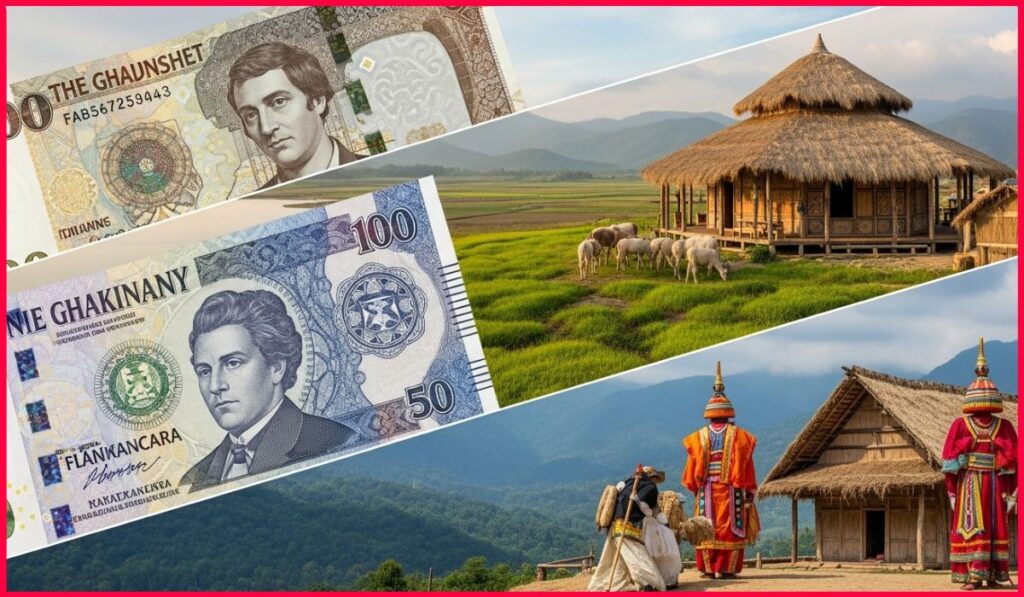
Money is never just money. The kroner represents something deeper about Scandinavian identity and how these nations see themselves in relation to the rest of Europe and the world.
When Denmark debates whether to adopt the euro, it’s not really debating currency conversion rates or transaction costs. It’s debating what it means to be Danish in an increasingly integrated Europe. The Danish krone represents monetary sovereignty, yes, but also cultural distinctiveness—a reminder that Denmark can cooperate deeply with European neighbors while maintaining its own path. Every time a Dane uses DKK, there’s an implicit affirmation of this choice, this particular way of being both European and distinctively Danish.
For Norway, the Norwegian krone connects to national mythology in powerful ways. Norway’s story is one of relatively recent independence—only achieving full sovereignty from Sweden in 1905. The NOK isn’t just a currency; it’s a symbol of that hard-won independence and the prosperity that followed. When global oil prices affect the krone’s value, Norwegians feel it personally because the currency directly reflects their nation’s fortunes. The Norwegian krone tells a story about a small country that discovered massive natural resources and chose to manage them wisely, building a trillion-dollar wealth fund that secures future generations.
Sweden’s krona carries its own cultural weight. Sweden has always positioned itself as independent, neutral, following its own path. The SEK reflects this—neither part of NATO historically (though that’s changing) nor fully integrated into European monetary systems. The Swedish krona represents a middle way, a Swedish solution to Swedish problems. When Swedes rejected the euro twice, they weren’t rejecting Europe; they were affirming their belief that Sweden knows best how to manage Swedish economic affairs.
Interestingly, all three countries share this crown symbolism in their currency names, which reveals their shared heritage even as they emphasize their differences. The kroner family of currencies is like siblings who’ve grown up and moved into separate houses but still gather for holidays, still share certain values and memories, still recognize each other as fundamentally connected despite their independence.
Practical Guide to Using Kroner When Traveling
If you’re planning to visit Denmark, Norway, or Sweden, understanding how kroner works in practice will make your trip much smoother. Here’s what you actually need to know beyond the textbook definitions.
First, understand that these are cashless societies in ways that can shock visitors from more cash-dependent countries. In Sweden especially, you might find shops, restaurants, even churches that don’t accept physical currency at all. They’ll take cards, mobile payments, contactless everything—but actual banknotes and coins? Not so much. This isn’t about being unwelcoming; it’s about efficiency, security, and the fact that handling cash has become expensive and inconvenient compared to digital alternatives. If you’re visiting Sweden, make sure you have a good credit or debit card that works internationally, because you’ll use it constantly.
Norway is similarly cashless, though slightly less extreme than Sweden. You can usually pay with cash if you insist, but people might look at you strangely, and smaller vendors might not have change for large Norwegian krone bills. The currency usage patterns here favor small transactions on card—buying a single coffee, a newspaper, a bus ticket—all done with a quick card tap. Many Norwegians go weeks without touching physical kroner, living entirely in the digital payment ecosystem.
Denmark is a bit more balanced but still heavily digital. You’ll find that Danish krone physical currency is more commonly accepted than in the other two countries, partly because Denmark has more tourists who expect to use cash. Still, cards are preferred, and you’ll notice that even street vendors and market stalls often have mobile card readers. The casual spending culture here assumes digital payment as the default, with cash as the backup option.
When it comes to exchange rates, none of these currencies are particularly cheap. The Scandinavian economy generally features high wages, high taxes, and high prices. What costs $5 in the US might cost 50-70 kroner in these countries—and that’s actually more expensive once you convert properly. Budget accordingly. The economic significance of strong Scandinavian currencies means your money doesn’t stretch as far here as it might in Southern or Eastern Europe.
One practical tip: ATMs (called “minibank” in Norway, “bankomat” in Sweden and Denmark) are available but often charge fees. It’s usually better to use your credit card directly rather than withdrawing cash unless you specifically need physical currency for some reason. And if you’re visiting multiple Scandinavian countries, remember that despite the shared “crown” concept, DKK, NOK, and SEK are different currencies with different values. A hundred Danish krone is not worth the same as a hundred Norwegian krone or a hundred Swedish krona. They’re separate currency systems that require separate conversions.
The Future of Kroner in an Increasingly Digital World
Looking ahead, the kroner faces an interesting paradox. These currencies remain deeply important to national identity and economic sovereignty, yet their physical forms are gradually disappearing from everyday life in Scandinavian countries.
Sweden is leading what some call the “cashless revolution,” with serious discussions about whether to become the world’s first completely cashless society. The Swedish krona increasingly exists only as digital information—numbers in bank accounts, amounts on payment screens, abstract values transferred electronically. Some observers worry this creates vulnerabilities: what happens to the payment system if the power goes out, if digital networks fail, if cyberattacks disrupt financial infrastructure? Others argue it’s simply the inevitable evolution of money, making transactions faster, cheaper, and more secure.
Norway is following a similar path, though with slightly more caution. The Norwegian central bank has studied whether to introduce a digital Norwegian krone as an official central bank digital currency (CBDC), which would be different from private digital payments. The idea is to maintain some public control over the currency system even as private companies increasingly dominate payment infrastructure. It’s a fascinating question: when money becomes entirely digital, who should control it—private banks and tech companies, or the central bank on behalf of the public?
Denmark has also explored these questions, balancing its traditional currency infrastructure with digital innovation. The Danish krone’s peg to the euro complicates matters slightly, since Denmark needs to consider how its currency policies interact with European monetary decisions. Still, Denmark is quietly innovating, testing new payment systems and exploring how to maintain the economic significance and stability of the DKK in a world where physical money matters less each year.
What’s remarkable is that despite all this digitization, none of these countries shows serious interest in abandoning their national currencies altogether. The kroner remains symbolically and practically important even as it exists increasingly as digital abstraction rather than physical reality. This suggests that currency is about much more than facilitating transactions—it’s about national identity, economic sovereignty, and cultural continuity in ways that persist regardless of whether the money takes physical or digital form.
Common Misconceptions About Kroner
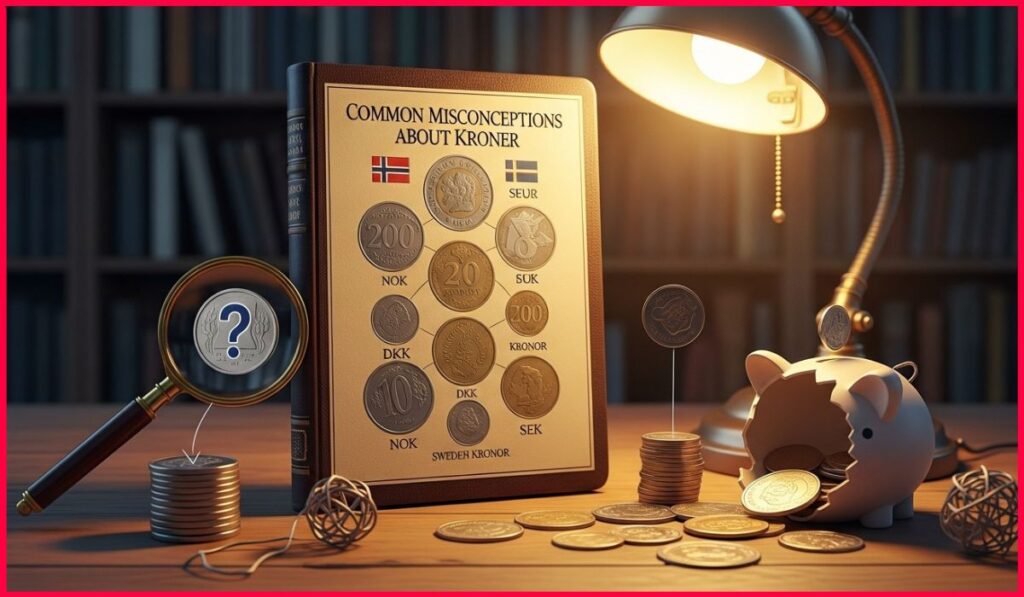
Let’s address some frequent misunderstandings about kroner that can cause confusion for those unfamiliar with Scandinavian monetary systems.
Misconception 1: “Kroner is one currency used across Scandinavia.” Actually, as we’ve explored, kroner refers to three separate currencies: the Danish krone, Norwegian krone, and Swedish krona. They share the crown symbolism and historical roots in the Scandinavian Monetary Union, but they’re distinct currencies with different values and independent monetary policies. You can’t spend Danish krone in Norway or Norwegian krone in Sweden without exchanging them first.
Misconception 2: “Kroner and kronor are different currencies.” This confusion is understandable. Actually, “kroner” (used in Denmark and Norway) and “kronor” (used in Sweden) are just different linguistic versions of the same concept—the plural of crown. The currency itself is different (DKK vs. NOK vs. SEK), but the words “kroner” and “kronor” both simply mean “crowns” in their respective languages. The spelling difference reflects Norwegian/Danish versus Swedish linguistic patterns, not different currency systems.
Misconception 3: “You need cash when visiting Scandinavian countries.” This is increasingly untrue. These are some of the most cashless societies on Earth. While having some physical currency as backup isn’t a terrible idea, you’ll primarily use cards and digital payments. In fact, in parts of Sweden, you literally cannot use cash at all in many establishments. The currency usage patterns favor digital transactions overwhelmingly.
Misconception 4: “Scandinavian currencies are weak because they’re not the euro.” The opposite is often true. The kroner currencies have frequently been stronger and more stable than many euro-using countries’ economies. The choice to maintain independent currencies isn’t about weakness; it’s about maintaining monetary policy flexibility. The economic significance of these independent currencies lies partly in their strength and the sophisticated economies backing them.
Misconception 5: “The kroner will eventually disappear as these countries join the eurozone.” While Denmark and Sweden are EU members, both have shown strong public resistance to adopting the euro. Norway isn’t even in the EU. The political will to maintain independent currencies remains strong, and there’s no indication this will change soon. The kroner appears quite secure as the official currency of these nations for the foreseeable future, regardless of broader European integration trends.
Making the Most of Your Kroner Knowledge
Understanding kroner isn’t just about memorizing exchange rates or knowing which Scandinavian countries use which currency. It’s about appreciating how money reflects culture, history, and national identity in meaningful ways.
When you handle Danish krone banknotes with their bridge designs, you’re holding a piece of Danish philosophy about connection and infrastructure. When you see the maritime themes on Norwegian krone bills, you’re experiencing Norway’s deep relationship with the sea. When you notice cultural figures on Swedish krona notes, you’re learning what Sweden values about its own history and identity.
The kroner teaches us that currency is never neutral. It’s always making statements about who we are, what we value, and how we want to present ourselves to the world. The choice to maintain three separate crowns—the DKK, NOK, and SEK—rather than merging into one currency or adopting the euro tells us that Scandinavian countries value their individual sovereignty even while cooperating closely with neighbors.
For travelers, this knowledge enhances your experience. You’re not just exchanging money; you’re engaging with centuries of Scandinavian history, with economic policies shaped by everything from World War I to modern oil discoveries, with digital innovation that’s reshaping what money even means. Every transaction becomes a small window into these fascinating cultures.
For those interested in economics or international finance, the kroner currencies offer case studies in how small, wealthy nations can maintain independent monetary policies in an increasingly integrated global economy. The ways Denmark, Norway, and Sweden manage their currencies provide lessons about flexibility, sovereignty, and the complex relationship between national identity and economic pragmatism.
Bringing It All Together
The kroner—whether Danish krone, Norwegian krone, or Swedish krona—represents something unique in our globalized world. It’s a currency that links past to present, connecting the Scandinavian Monetary Union of the 19th century to the digital payment systems of the 21st. It’s money that carries the symbol of the crown while serving modern democracies. It’s physical banknotes and coins that few people actually use anymore, yet which remain culturally and symbolically vital.
Understanding kroner meaning opens up insights into the Nordic region that go far beyond simple currency definition. It reveals how these nations balance independence with cooperation, tradition with innovation, national identity with international engagement. The kroner is practical money for casual spending and leisure usage, yes, but it’s also a statement of values, a marker of sovereignty, and a tangible link to shared Scandinavian heritage.
Whether you’re planning to visit Denmark, Norway, Sweden, Greenland, or the Faroe Islands, or you’re simply interested in how different countries approach currency systems and economic identity, the story of the kroner offers rich material for reflection. It reminds us that even something as seemingly mundane as money carries layers of meaning, history, and cultural significance that reward closer examination.
The next time you see kroner mentioned—in travel guides, currency exchanges, or financial news—you’ll understand it’s not just another foreign currency with a funny name. It’s the crown currency of the north, carrying centuries of history into an increasingly digital future, representing three nations that chose to keep their own monetary identities while remaining deeply connected to each other and to the world. That’s the real meaning of kroner in 2025: continuity and change, independence and cooperation, tradition and innovation, all wrapped up in currencies that bear the ancient symbol of the crown.

Food lover, recipe creator & the heart behind NoshCrafters.com. Olivia shares mouthwatering, easy-to-make dishes that turn everyday meals into unforgettable bites. When she’s not experimenting in the kitchen, she’s busy plating up inspiration for home cooks everywhere.